
ASTC recently launched Professional Pathways in Informal STEM Learning (ISL), a suite of tools—the Framework, Self-Assessment, and Learning Plan—and complementary resources that support professional learning and career development for ISL professionals across the field.
Our Communications team sat down with four ASTC staff involved in the development of Pathways to learn more about their ISL career paths, what most excites them about the tools, and their thoughts for the future with Pathways in hand.

Amanda Fisher
- Years in the ISL field: 22, including five part-time at a science “edutainment” organization doing birthday parties, camps, and afterschool programs, 11 at the Oregon Museum of Science and Industry (OMSI), and six at ASTC.
- Current role: Associate Director of Programs. I work on a variety of leadership and development projects, including our New Leaders Fellowship Program, LEGO® Playful Learning Museum Network, and the IF/THEN® Initiative.
- Entry point to ISL: I studied chemistry in college, but after spending a few summers as a lab tech, I realized the monotony of that work wasn’t for me. I also tried teaching middle school math in a more formal setting, but that didn’t go well either. I then joined OMSI as an outreach educator in 2009 and fell in love with the job! I worked in a number of roles at OMSI and eventually found my niche in creating programs and facilitating professional development, which I now get to do at a national level with ASTC.
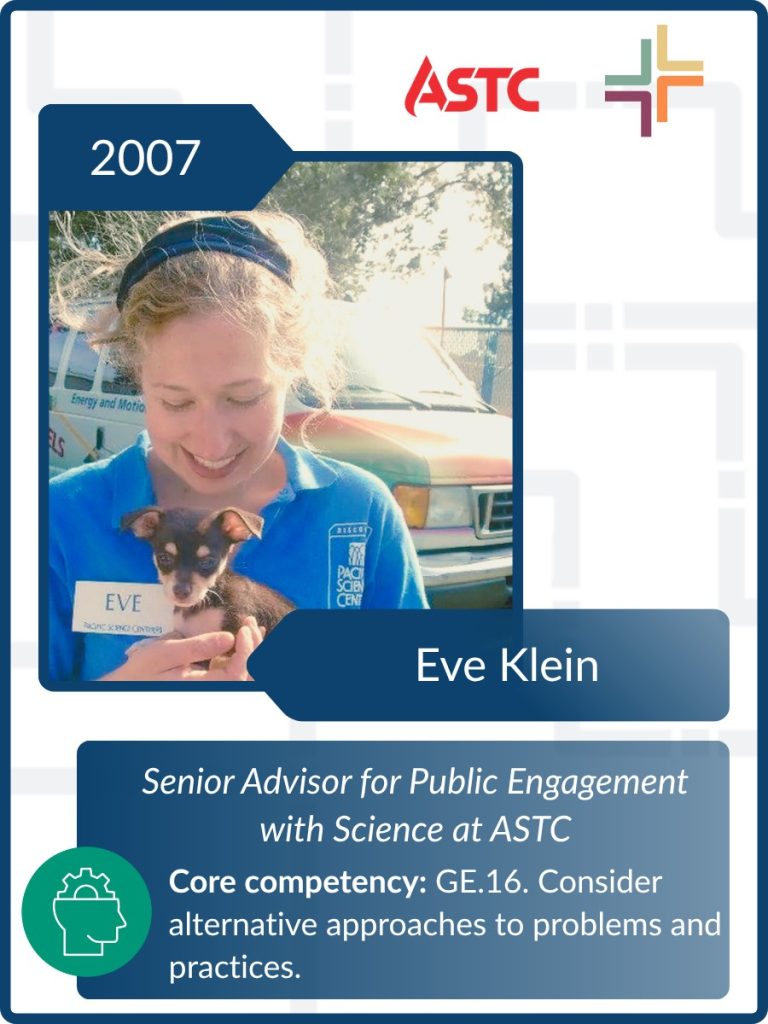
Eve Klein
- Years in the ISL field: 24
- Current role: Senior Advisor for Public Engagement in Science. I manage a portfolio of projects that help us better understand the broader field of science engagement, especially how we engage with science outside of science centers. One of my projects right now is bringing together various organizations to engage in and give a public voice to AI.
- Entry point to ISL: In high school, I reached out to the American Museum of Natural History to fulfill an internship requirement. While there, I made a website that explained astrophysics concepts for the general public. During college, where I studied astronomy, I traveled to South Africa with a mobile physics education department. The experience was both energizing and thought-provoking, and prompted me to reflect on the value and impact of informal science learning and public engagement in science. I then joined Pacific Science Center, where I eventually led their outreach department and developed a deeper interest in science communication and how public engagement fits into the scientific enterprise.

Jenny Crayne
- Years in the ISL field: 17, including roles in environmental education, museum education, science communication, and research and evaluation—most recently with OMSI.
- Current role: Manager of Programs. How I sum it up for folks is that I work for a professional organization that supports the science centers and museums they grew up going to, helping those institutions build capacity and have more impact.
- Entry point to ISL: I graduated from college in 2008 with a degree in environmental studies with a humanities focus, which gave me a deep appreciation for the connections between people, science, and place, but no clear career trajectory. I ended up getting an AmeriCorps position with an itty-bitty nonprofit doing environmental education with fifth graders in rural Oregon. I loved it. I really liked the programs and felt that we connected them to local places and ecosystems in ways that resonated deeply with the students. That set off what has turned out to be a primary theme of my career: figuring out how to more effectively engage all kinds of people to think about, appreciate, and use science in their lives.
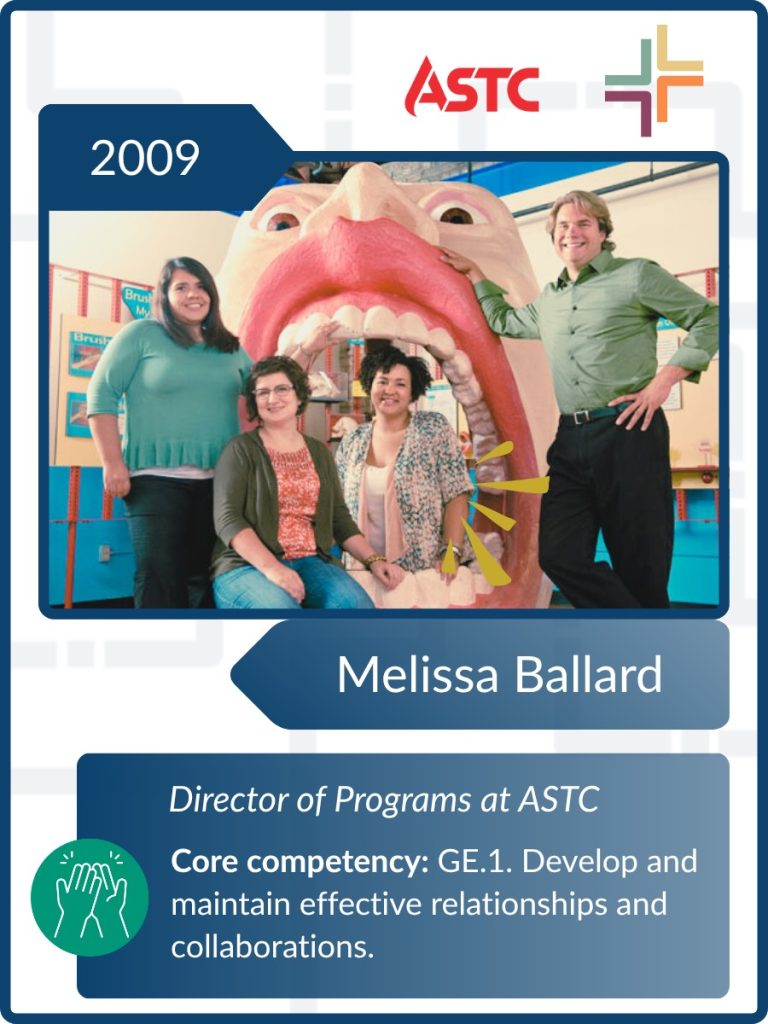
Melissa Ballard
- Years in the ISL field: 17 with a short break for graduate school.
- Current role: Director of Programs. I support a team that builds the capacity of science center and museum professionals through practice-related tools, grants, and research. I also support communication and budgeting efforts, and am a member of ASTC’s leadership team.
- Entry point to ISL: After college, I was headed to graduate school (which I abandoned after one year), but first, I needed a summer job! I couldn’t imagine sitting at a desk all day, so I applied for a science educator position at the local science center I grew up going to, figuring I could use my engineering degree. I found it to be intellectually challenging—I couldn’t just use college-level definitions to explain concepts, I had to find new ways to talk about them. From there, I joined the Afterschool Alliance, advancing policy and advocacy for afterschool programs, then the Center for Advancement of Informal Science Education (CAISE), before landing at ASTC.
What excites you most about Pathways?
AMANDA: That it creates a shared roadmap of the work ISL professionals actually do. Like many, I ended up in ISL by accident which meant I had unique strengths from my somewhat varied past work, but I didn’t know what other skills were important in this field. Pathways lays those out in a way that’s easy to understand and act on. It can both affirm what people are already doing well and help them see how to keep growing.
EVE: Early on I didn’t even see what I was doing as a potential career. I didn’t recognize that it was something I could spend years—and now decades—doing. Once I started to feel like I wanted to keep growing in the field, I found I didn’t know what I didn’t know; I didn’t know what kind of professional learning opportunities to ask for or to seek out. There were other roles at my organization that intrigued me, but I felt like I didn’t quite have the language to talk about what it would take to move through the ranks. I’m excited because Pathways helps provide some of this language.
JENNY: That it gives language and professionalism to the field. When I first put on that cactus costume to explain plant adaptation during my time in AmeriCorps, I didn’t have a name for what I was doing. Even as my career progressed and I had a broader network and deeper knowledge, I didn’t really understand that ISL was a field of work that other people and organizations were contributing to—I was having to invent a career path for myself. Even with Pathways, it’s each person’s responsibility to build their path, but to see it in this broader context of distinct competencies is helpful.
MELISSA: That it’s concise and easy to follow. What also excites me is seeing the evolution it has gone through over multiple years, from its first framework-only iteration to the suite of tools it is today. So many amazing and multi-talented people helped get it to this point and working with them has been rewarding too.

When developing Pathways, did anything surprise you? Were there any “aha” moments for you personally?
JENNY: It was amazing to me that as I helped develop Pathways my own competencies grew in real time. For instance, I was significantly involved in the website’s development, and before this experience I didn’t know anything about WordPress or working with a web developer. Now I feel like it’s a competency that I have established through developing these tools.
MELISSA: When the team conducted those early listening sessions floating the idea of a competency framework I was surprised by how many people wanted something like this! And that excitement and interest across the field has only grown since. For example, when we launched Pathways, so many professional associations signed on to help us spread the word and we received such positive feedback from ISL professionals. It was encouraging to see this level of support for Pathways in only its first few weeks.
AMANDA: Honestly, one of my biggest “aha” moments was realizing that a professional competency framework (a phrase that meant absolutely nothing to me when we started) could actually be useful for our field. It sounded so jargony: competencies, indicators, descriptors, domains…But once we dug in, I started to see the potential and the power of breaking things down. It’s not enough to just say, “improve your communication skills,” which is way too vague to act on. The Framework breaks it down into a series of competencies that show what it means to have good communication skills, and breaks those competencies down further with concrete descriptions that show what it looks like in practice. That level of detail makes it so much clearer to identify what skills are necessary in this work, and how you can either demonstrate them or work on building them.
If Pathways had existed earlier in your career, what impact do you think it could have had?
MELISSA: Honestly, when I first started my career out of college I think I would have been surprised, and a bit overwhelmed, to learn that ISL was a concrete field. A bit later on in my career, I think it would have helped me understand the administrative and operational nuts and bolts of how an organization works which are skills I really lacked, but also needed, at that time.
AMANDA: When I first started working in a museum, I didn’t even consider it could be a long-term career. As an outreach educator, I loved driving around the Pacific Northwest, wowing students with liquid nitrogen demos and hydrogen balloon explosions, but I saw it as just a really fun job—one step along the way to “figuring out what to do with my life.” Eventually, a few experiences (like my first ASTC conference!) started to hint that maybe there was something more to my job, that there was potential to make it into a fulfilling career. I was fortunate to have these opportunities, but if I’d had Pathways earlier on, I could have connected those dots much sooner. My hope is that it gives others entering the field that clarity and sense of belonging right from the start.
EVE: It would have given me the language to ask for what I didn’t know I wanted or needed to expand my career.
JENNY: I think it would have helped me focus some of my graduate school course selection and professional learning activities. For example, at OMSI, our team had a regular book group as part of our peer learning efforts. Having Pathways in that context could have helped us identify and home in on areas that our team needed to work on collectively.
How do you plan to use Pathways in the year ahead?
AMANDA: I’m focused on getting Pathways into as many hands as possible and encouraging people to adapt it to their own needs. I’ll be sharing it with different groups I work with, including emerging leaders in our New Leaders program. I think it’ll be a fantastic resource for them as they figure out what kind of careers they want to build and what skills they want to develop. Beyond that, I plan to share it through workshops, conferences, and conversations across the field so that it becomes a living tool, not just a static document.
EVE: I plan on using Pathways in a couple of ways. Now that I’m mid-career I want to be more intentional about reflecting on my strengths and identifying areas where I want to continue to grow. I also want to use it to support others. Several times a year I’m contacted by someone who wants to hear about my career trajectory and how I’ve carved out a career for myself in science engagement. I’m excited to share Pathways to help them build language for what they want to do and what responsibilities they want to take on.
JENNY: I started my current role at ASTC less than a year ago, and so I’m interested in a couple of areas for my own career development, especially website/technology and leadership/management— competencies that, up until recently, I haven’t had the opportunity to finetune. I plan to use the Learning Plan to help me figure out ways to intentionally develop these competencies within the context of my current role.
MELISSA: Over the next year, as the lead of ASTC’s professional learning and impacts program team, I’ll be working with other members of the team to assess and make cross-departmental considerations of how we, as an organization, will uptake and integrate Pathways into our various offerings for members.
What is your favorite Pathways competency and why?
EVE: General Expertise 16: Consider alternative approaches to problems and practices. I think we often get stuck feeling frustrated or ruminating on the problems we’re confronting. Sometimes you just need to fundamentally rethink what the problem is, be flexible, and bring in outside expertise. A lot of what we do in ISL is unique, but there’s a lot we could and need to learn from other fields.
JENNY: Job-Specific Expertise 1: Understand basic STEM content and processes. This is the area that makes me most excited because I just can’t get enough of exciting STEM content and learning new STEM facts—it keeps me going! For example, the other day I was learning about recent research in infant gut bacteria and human breastmilk, and it blew my mind thinking about how our understanding of human health (and everything else!) is still evolving. As an ISL professional, we need to be able to balance budgets and develop strategic plans and engage community partners and all that, but I never want to lose sight of science itself, and what it is revealing about the world we live in.
MELISSA: General Expertise 1: Develop and maintain effective relationships and collaborations. Interpersonal and communication skills will get you very far, whether they are verbal, written, or visual. They’re how you get people on the same page, how you gain support for what you are proposing, how you translate data powerfully, and how you can effectively advocate for yourself.
AMANDA: Audiences & Impact 5: Understand and respond to the interests, and priorities of communities and audiences. For me, this is at the heart of ISL. It’s not about pushing out programs and hoping they land—it’s about listening, co-creating, and building relationships that last. That’s what makes our work meaningful.
Forge ahead on your own ISL Professional Pathway!
Learn more and explore the resources at astc.org/isl-pathways.