
Launched in 2023, ASTC’s Community Science Partnership Planning Seed Grant program supported new and emerging collaborations between ASTC member institutions and community-based organizations looking to deepen their relationship and collaborate to advance local priorities.
Each grantee team received $8,000 – split equitably – to enable their participation in the five-month program which included strategic training workshops to help them develop an actionable Community Science project plan. You can learn more about the ambitious plans our grantee teams developed, including those that tackled mental health, sustainable agriculture, and Indigenous land stewardship, in our past blog post.

ASTC partnered with J. Sickler Consulting to better understand the partnership processes, outcomes, and the extent to which these collaborations both delivered on proposed initiatives and reflected the ASTC Community Science Framework Attributes. Evaluation methods included semi-structured interviews with grantee teams and a rubric-based tool that assessed how closely each team’s final written project plans aligned with these Attributes. We are thrilled to share a summary of the evaluation’s key findings here:

This program evaluation focused on three key areas:
- Partnership journey – What was the relationship-building journey of participants? What was the change in the relationship from the grant period’s outset to its completion? What were the breakthrough moments and insights in the collaboration?
- ASTC’s Community Science Framework – How were the Community Science Attributes centered by grantee teams? How did teams interpret and embody these Attributes? How deeply were these Attributes articulated in their project plans?
- ASTC support – What did ASTC’s support provide and what were its limitations? In what ways did the support enable grantees to achieve or advance their work where they might have otherwise struggled? How can this support be improved and/or what further support would be beneficial to community teams?

Key Findings Across Projects
The partnerships supported through ASTC’s Partnership Planning Seed Grant Program led to the development of strong and trusting relationships, and most teams successfully developed plans that set them on course to enact authentic local collaborations, grounded in equity, that address community priorities. More specifically, there were several cross-cutting themes that across the seven grantee teams:
- All seven grantee teams felt positively about their partnerships. From their perspectives, they were pleased with what they were able to accomplish in this collaborative effort.
- Almost all involved organizations had some initial familiarity with one another; only one partnership was completely new. Often, the degree of prior familiarity informed how the teams decided to work together in their collaboration.
- Project partners were most proud of the relationships they developed and/or deepened through the grant process that feel lasting and substantial for the long-term.
Grantee teams also shared essential feedback on how ASTC support—which included funding, strategic training workshops, and meetings with project advisors—benefitted their partnerships and how the program could be improved for future iterations. For example:
- Teams described how ASTC support enabled them to not only develop great community science projects, but productive collaborations.
- Grantees praised the financial support, drawing attention to the fact that few funders offer investment in this essential, preliminary stage of work.
- Teams voiced concerns about the time commitment required for some aspects of the trainings.
- Suggestions for improvements also included incorporating more community voices in trainings, bolstering cross-team sharing and peer learning, adjusting workshop logistics, and allowing more flexibility in applying the Community Science Framework.
A New Rubric for Community Science Attributes
A key evaluation deliverable was a rubric-based assessment tool that evaluators used to examine how Community Science Attributes were incorporated into the final project plans developed by grantee teams (see page 31 in the full evaluation summary report). For each Attribute, a four-point achievement scale was developed and applied: Struggling, Making Progress, Succeeding, and Exceeding Expectations. Each Attribute was examined to identify its critical ideas, and the ASTC team and the evaluators collaborated to ensure that the criteria accurately reflected the Attribute’s core ideas and could be used to evaluate written project plans. Each partnership resulted in a written plan which included a unique profile of strengths and challenges related to Community Science Attributes. In most areas evaluated, 4 of the 7 plans were scored as “Succeeding” or higher.
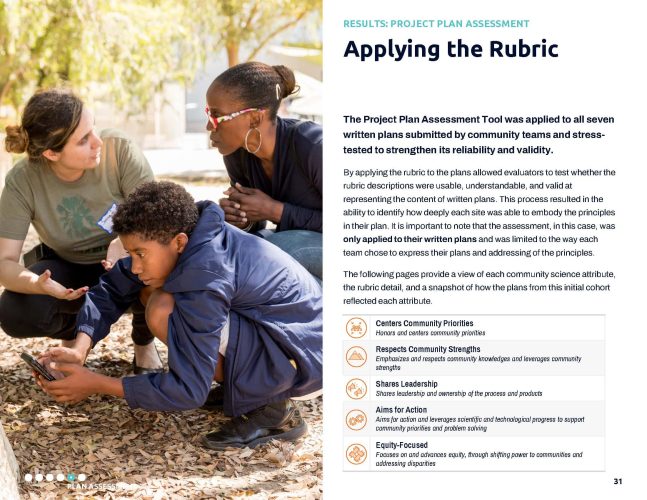
ASTC’s Community Science Team is working to leverage this project assessment tool into a public resource teams can use to critically reflect on their Community Science work and explore ways to incorporate Community Science Attributes more fully into their projects and programs. We look forward to sharing the next version of Attributes Rubric later this year. For more information, check out J. Sickler Consulting’s post on using rubrics in evaluation.
To stay up to date on future resources and training opportunities from ASTC’s Community Science Initiative, join our mailing list!