Learning Plan

A tool for charting your path for professional growth.

Your Learning Plan can guide the ways you build, strengthen, and apply the competencies you’ve identified with the Pathways suite of tools. The Self-Assessment provides context, structure, and vocabulary that can inform your Learning Plan. You may find the Learning Plan more useful after reflecting on your competencies and where you are on your professional learning path.

How do I build my Learning Plan?

After you’ve reflected on your professional competencies in the Self-Assessment, you can begin creating your Learning Plan. 

  • First you’ll identify the competencies that are priorities for your current work and career goals. 
  • Then you’ll consider why those competencies are priorities and what changes you hope to see as a result of your professional learning.
  • Finally, you’ll reflect on timing, barriers, and other considerations, then develop action steps aligned with your priority competencies.

Learning Plan

Complete the fillable PDF digitally or print a copy to record your priorities and action steps.
Learning Plan Image

Tips

  • Developing your Learning Plan can take significant time and energy. Consider completing it over several sessions.
  • You may want to work together with a colleague, or in a group setting such as a workshop or classroom, to complete your Learning Plan.
  • When completing Step 3 (How Will I Get There?), consider a range of strategies for professional learning.
  • Remember that professional learning is an iterative, ongoing process and every learning path is unique and personal. You may want to revisit the Pathways suite of tools on a monthly, semiannual, or annual basis. After all, your objective is not to come to the end of the path, but to continue the journey.

Strategies for Professional Learning is a helpful reference to use alongside the Learning Plan

Examples of Pathways tools in use

Discover how three ISL professionals with varying roles and experience used the Pathways Self-Assessment and Learning Plan tools to reflect on their competencies and make a plan for professional growth.

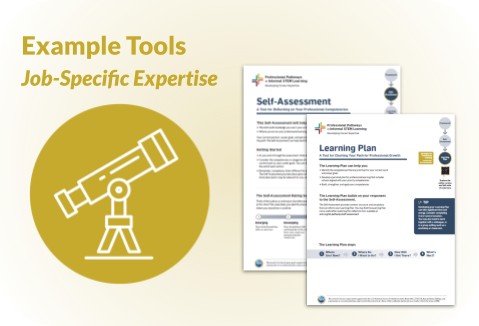
A planetarium manager aiming to develop their understanding of informal education identifies areas for growth in the Job-Specific Expertise domain.

A new ISL professional working in a camp setting wants to develop their financial and budget management competencies in the Operations domain.

An experienced ISL professional in an administrative role focuses on building their problem-solving competencies in the General Expertise domain.

What's next?

After you’ve built a Learning Plan with your priorities and next steps, you can begin building your competencies. Visit the Resources page for articles, online courses, professional organizations, and other tools that can support your plan.
NSF-Logo.png


This material is based upon work supported by the U.S. National Science Foundation under Award No. 2215274. Any opinions, findings, and conclusions or recommendations expressed in this material are those of the author(s) and do not necessarily reflect the views of NSF.

Scroll to Top