
When I started working in a natural history museum, I knew a lot about how people learn and how to facilitate and support learning. But I knew very little science—certainly not enough to help people understand evolution, climate change, or even why some birds have bright colors and others don’t. My colleague and co-author on this piece, Dennis Schatz, was the opposite. He started his career intending to be a research scientist but became fascinated with how people learn, especially in informal science settings. When he shifted to working in a science center, he had to figure out how to plan educational programs and manage people. While we each brought significant expertise to our work via these different entry points, we also had gaps in our skills and knowledge.
Our stories are not unique. People often enter informal STEM learning (ISL) work through a related specialization, like science, administration, design, or even theater, but they might not have a broad understanding of common ISL practices or terminology.
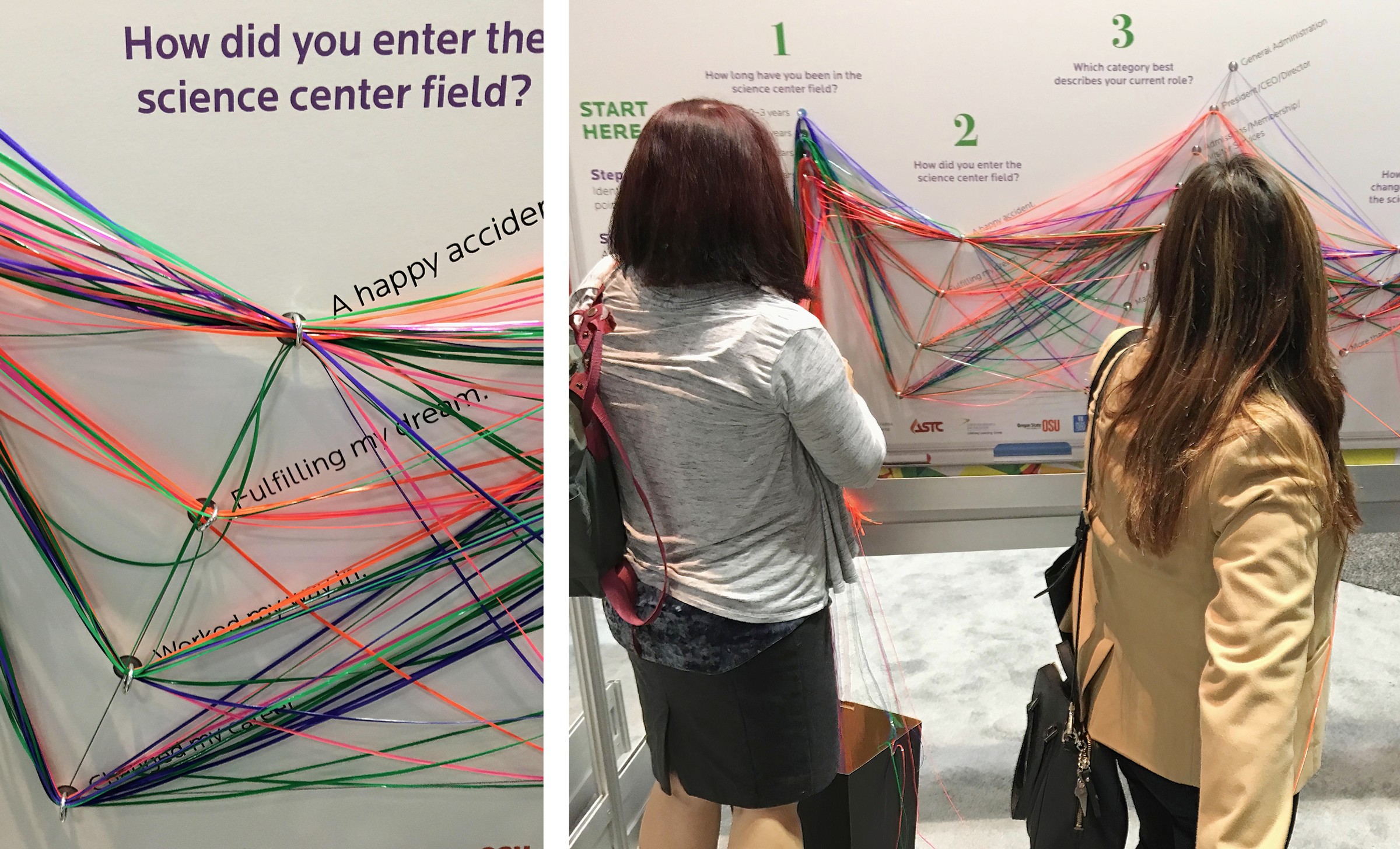
ASTC Annual Conference attendees reflect on their career paths and use string to map the various ways they entered the ISL field. Photo by Kris Morrissey.
When Dennis and I met—then already decades into our careers (I was directing the University of Washington’s Museology graduate program and Dennis was Pacific Science Center’s vice president)—he asked me, “How can we help people better understand ISL work and help them be better at doing it?” Clearly there were a lot of options for professional learning—including academic programs, conferences, and more—but we knew from experience that it was not always easy to find or access the right learning opportunity in a field that is so wide-ranging and diverse. In the words of one ISL professional, “There’s a lot of different ways that people enter our field…It’s not like, you know, you go to school and get an accounting degree, and you become an accountant.”
To answer Dennis’ question, we first needed to look at the bigger picture: how do we describe what ISL work is?
A Journey into the Thrilling World of Competency Frameworks
When we, and our peers and colleagues, came across the idea of competency frameworks we were intrigued. Essentially, competency frameworks describe what people need to be able to know and do in a particular area of work (i.e., “competencies”). By articulating what those competencies are and what they look like in practice, competency frameworks can help people define, develop, and align professional learning to meet their goals, whatever they may be.
To me and Dennis—and to be clear, there were many others pondering this question as well—the concept of a competency framework aligned with the self-directed, choose-your-own-adventure ethos of informal learning. We felt a framework could help ISL professionals identify skills and knowledge they wanted to develop based on their personal and professional goals. Then they could decide how to meet those goals based on their unique circumstances and learning preferences. A framework like this could help support ISL professional learning in a more systematic way.
After some initial planning and discussion with our research partners—ASTC, COSI’s Center for Research and Evaluation, and Oregon State University’s STEM Research Center—the team received support from the U.S. National Science Foundation to develop it.
For a full list of Pathways contributors and advisors, visit the project team page.
Creating the Framework: An Exercise in Listening and Iteration
Our first hurdle arrived quickly. To create an effective framework, we had to identify core competencies relevant across the entire ISL field, including science centers, zoos, aquariums, children’s museums, natural history museums, and more. Given that professionals within this wide range of institutions have such diverse responsibilities, we weren’t even sure if, much less how, we could describe ISL work at a level that was both specific and broad enough to be useful. “Greet wily first graders coming off the bus for ankylosaurus camp” was obviously too specific while “provide leadership” was likely not specific enough!
To tackle this challenge, we reviewed frameworks from allied fields, developed a solid research protocol, and launched a series of workshops to hear directly from ISL professionals from across the U.S. about their responsibilities, and the skills and knowledge they needed to do their jobs. We then engaged in the lengthy, complex, and dazzling process of analyzing and categorizing what we heard (see photo below).

The project team analyzed feedback from the field, to inform the development of the initial Framework. Photo by Kris Morrissey.
Eventually, and with much relief, we began to see patterns. We saw a distinction between competencies that related to a person’s specific position, and those that were more general, like communication and problem-solving. We also saw that some competencies focused internally (e.g., operations and administration) and some externally (e.g., understanding and working with visitors and community partners).
From these data we pulled together a preliminary framework around four domains of competencies:
- General Expertise – how professionals work with others to solve problems and accomplish goals
- Job-Specific Expertise – how professionals understand and engage with ISL practices and activities
- Operations – how professionals engage with organizational systems and structures
- Audiences and Impact – how professionals navigate relationships between their organization and local communities
When we tested it with ISL professionals, feedback was generally positive, but there were two areas that suggested further work:
- People often asked for more support and guidance. They wanted tools and resources to help navigate and apply the framework. They asked, “How do I know if I’m competent in that area?” or “This could be very useful if only it included…”
- Some people also commented that the framework’s structure implied that professional development meant moving “up” into management, while others saw professional development as a way to help them become more competent in their current position, or to specialize or move laterally.
With this input, we set about revising the framework and, thanks to significant input and review by professionals across the field, Professional Pathways in Informal STEM Learning was created.
Introducing: Professional Pathways in Informal STEM Learning
Pathways is now more than a framework—it’s a collection of integrated, flexible tools designed to support professional learning and professional development in any ISL context.
The finalized Framework sticks with the four original domains: General Expertise, Job-Specific Expertise, Operations, and Audiences & Impact. And each domain includes four categories of three to five competencies (see image below).
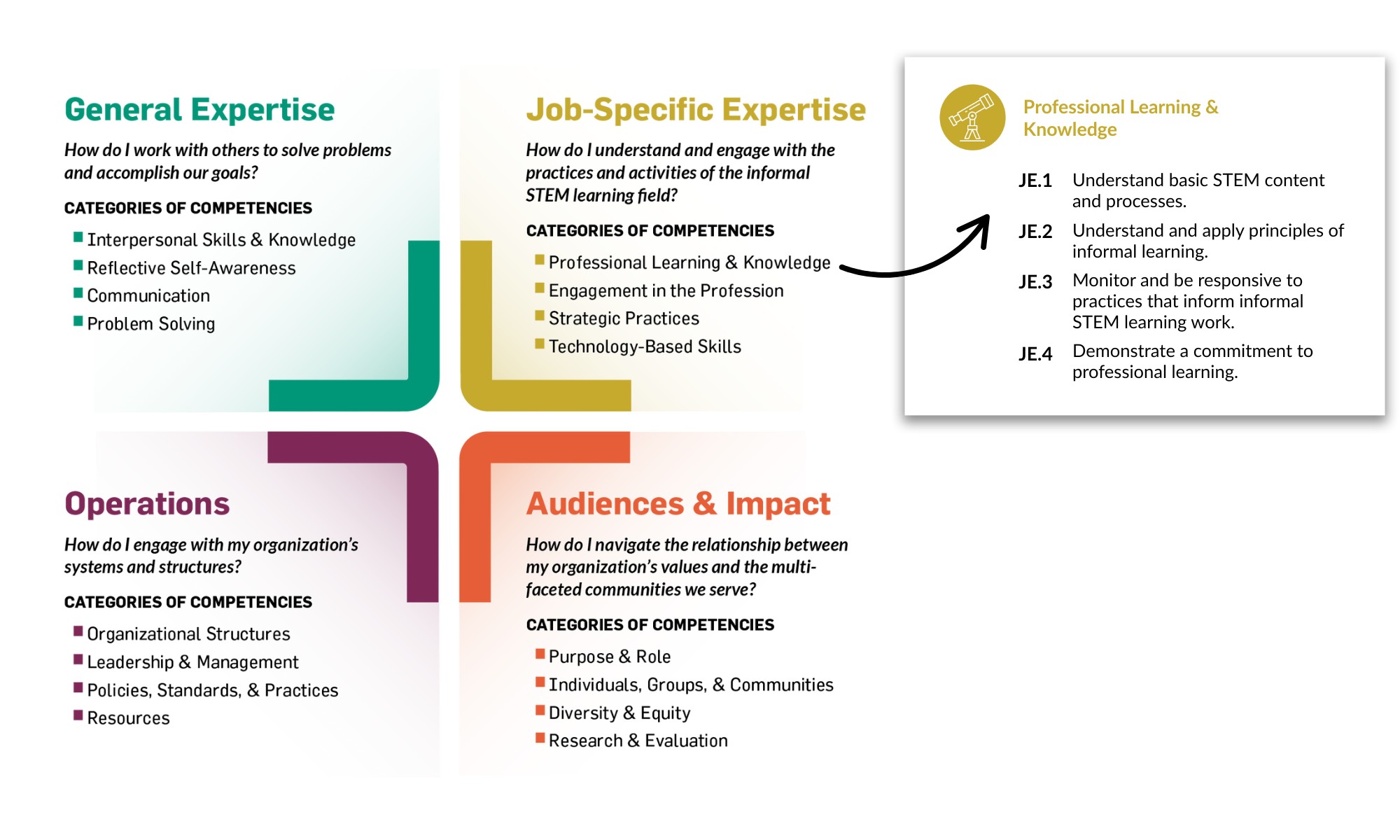
In total, the Framework includes 66 competencies that can help any ISL professional identify the skills and knowledge they use in their daily work.
The Pathways Self-Assessment allows professionals to better understand their own skills and knowledge, where they are on their professional learning path, and the competencies they may want to develop. As the title suggests, this tool is unique to each person based on their job circumstances and aspirations, and is not meant to be a performance evaluation tool! Because competencies can look different in different situations, each includes examples of what a competency might look like (see photo below) based on conversations with professionals across the field and the team’s analysis of relevant job postings.

The Pathways Learning Plan helps identify competencies that are priorities for a professional’s current work and/or career goals and connects them to specific professional learning actions.

A Learning Plan excerpt from a planetarium manager who filled it out as part of our beta testing efforts. Notice that it's highly personalized to this professional's context, including team dynamics, work time allocation, and funding realities.
In addition to these tools, Pathways also includes:
- Strategies for professional learning – practical approaches individuals, groups, or organizations can use to meet specific learning goals.
- Resources – a selection of books, articles, websites, and more that current ISL professionals recommend and use.
- Key terms – a brief glossary of terms used throughout Pathways, such as evidence-based and audience, that hold specific meaning in the ISL context.
Critically, Pathways does not suggest what or how an individual should learn, just like a map doesn’t tell a person what their destination should be or what path they should take to get there. But, Pathways can help individuals decide the direction they want to go and help them navigate their learning journey.
Useful, Useable, and In Use?
Throughout Pathways’ development, the team felt it was important that all resulting tools be:
- Useful – they would actually help individuals, organizations, and institutions get better at their work.
- Useable – they would be flexible, practical, and easy to apply in real circumstances and settings.
- In Use – Professionals across the field would use them in their work.
How do you think we did? Let us know!
Pathways Isn’t Just for Individuals
While we developed Pathways with individuals in mind, it can be useful for institutions, organizations, academic programs, and professional organizations as well. For example:
Institutions and organizations can:
- Provide time for staff to explore, use, and engage with Pathways individually or as a group
- Use the Framework to create onboarding tools, shape internships, or consider team composition
Academic programs can:
- Use the Framework to review curriculum and structure internships
- Help students identify career direction or select courses and thesis direction
- Integrate Pathways into a career exploration course
Professional associations can:
- Host sessions during their conferences where participants explore, use, and engage with Pathways
- Organize professional learning experiences, either in-person or virtually, to train others to use Pathways

The Paths Ahead
I was once asked in a job interview how I juggled all my responsibilities. I responded that I thought I was good at distinguishing between what needs to be done “well” and what can be “good enough”. This has been an ever present thread throughout my career.
Our hope is that Pathways helps people decide, on an individual level, what’s important to them, what they need to be “good enough” at, and where they’d like to excel based on their personal and professional goals. Because, as many of us know, professional learning can be exhausting, challenging, confusing, and sometimes even boring! It can also be expensive, time-intensive, and frustrating. But, if it is meaningfully integrated into practice, it can also be empowering, enlightening, and fun. It can help individuals thrive as professionals, and help ISL institutions do the same.
Ultimately, that’s what we want: for ISL institutions to thrive, to be places of excitement, learning, and curiosity. And for that to happen, the people who work in these places must also thrive and feel this excitement, learning, and curiosity in their daily work.
Thank you to all who have helped us and our colleagues along this journey of Pathways’ development. We hope it helps you achieve your aspirations and, even more fundamentally, we hope it gives individuals and institutions the confidence to aspire for great things for our field and our world.
What Your Peers Think About Pathways…
“It shows you where you have gaps or weak points.…it makes you just more aware of what skills you need to build, or what you may need to focus on in your professional development.”
“It is a chance to, to really take some time…for self reflection, and see where you are at in your current role or space, and begin to chart out where you would like to go.”
“[It] will be incredibly useful to the informal learning community. Although this is focused on informal STEM learning professionals, I can certainly see others using it, even if their roles are not focused on STEM.”
Tell us what YOU think about Pathways!
This material is based upon work supported by the U.S. National Science Foundation under Award No. 2215274. Any opinions, findings, and conclusions or recommendations expressed in this material are those of the author(s) and do not necessarily reflect the views of NSF.

