You’ve just found out you need to organize a food-based event or exhibit (or program!) at your museum… write your initial reaction.
- EXCITEMENT & NERVOUSNESS!
- 🙁 Lots of pressure/lots of things to consider
- Health & safety: can we do this in a sanitary way?
- Check for allergies
- Can it take place outside?
- Panic!! No food near the art!!
- Fun!
- What type of food, who’s eating what?
- Piece of cake! 🍰
- Cool! I’m working on one now! Oysters–yum 😊
- Yay! Don’t shut us down!
These responses emerged from a session at the 2026 New York City Museum Educators Roundtable, titled “No Food in the Museum! Actionable Food Pedagogies to Engage Community Voices and Uplift Culture.” Led by our team from the New York Hall of Science (NYSCI), the conversation revealed a baseline for how museum educators thought about food across various types of NYC museums—from science centers to children’s museums, art museums, history museums, and other cultural institutions.
From the responses to the talkback board’s prompt above, it was clear that everyone had some sort of excitement around food and saw its connective potential. However, while some folks had more experience incorporating food in museum programs, others had less experience and felt anxious about trying. As we talked, various sources of friction and apprehension arose—budgets, allergies, messes, logistics, museum policies, and pests.
Looking closer at these anxieties revealed how almost everyone in the room assumed that doing an educational program on food meant feeding people, or having food physically present. These quiet baseline assumptions seemed to be the foundation on which a trove of silent hurdles and anxieties built—holding professionals back from incorporating an otherwise exciting, connective, and community-oriented component into museum learning experiences.
It’s clear more work can and needs to be done around shifting the ways we use food in museum education. This is a call to reframe food as a learning tool, rather than an added draw or “nice to have”—to broaden our toolkits as museum professionals, and to deepen relationships with the communities our museums serve. Here, we offer three frames for leveraging food in the museum: Food as the topic, food as a material, and food as a convener.
Food as the topic

Domains like STEM (science, technology, engineering, and math) and the fine arts—and on the whole, cultural institutions like museums—have historically excluded people, types of knowledge, and art on the basis of race, culture, and socioeconomic status. Introducing food as a topic to be put in conversation across disciplines through our museum programs can be a missing link that invites everyone’s experiences.
When we talk about food, eating is just one part (albeit, an important one) of our historical engagement with food as a species. Food is timeless and ageless. It is something everyone has to engage with on a daily basis, and subsequently, something everyone has a story around. As a result, it’s a topic that can be exciting to broad audiences across multiple walks of life, and generational divides.
An educator from an art museum brought up the tension of art conservation and food materials—“How close can the food go to the art? Could we do it outside?”—yet, no one had said this food program needs to be focused on eating, or even feature edible materials.
A colleague from our museum chimed in, “I’m not an art major, but I think there’s art about food, about agriculture, about the making of food.” And she’s right. Art that takes food as a central topic can depict food practices, food spaces, food workers, agriculture, or ingredients—all ways of talking about food and what it can connect with, without feeding people.
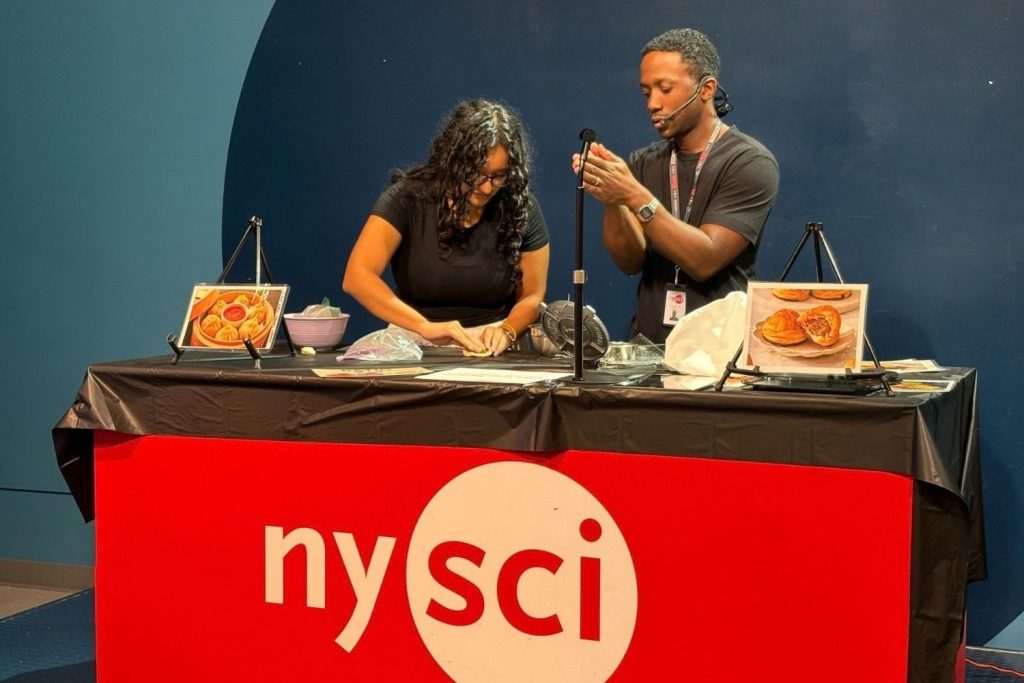
Another museum educator noted ways of using materials that represent food, which minimizes messy logistics and waste: “We are thinking about how to do our food programs in a way that’s sustainable, and that maybe doesn’t use food materials.” They motioned down to the jellybean dumplings we had folded together as a hands-on portion of the session, “For example this could be clay instead of dumpling wrappers to make it reusable.” In museums where policies make it prohibitively difficult to incorporate actual food, introducing food as a topic, without anyone eating it, can be a needed reorientation forward.
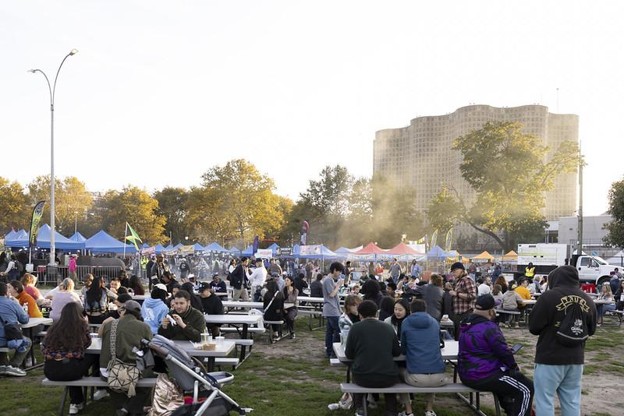
Sometimes, even the mention of food sparks a different kind of engagement—signaling that perhaps the museum is reaching out to people who would otherwise think this institution is not for them. In community-based work at our science center, food has come up time and time again as a topic that spurs joy and connection among youth and caregivers in our community. When asked about what cultural topics our community members would like to continue to see at our museum, nearly 60% of attendees of our 2024 Community Celebration event said, “food and cooking.” In response, we’ve turned to exploring food as a topic to make relatable analogies that enable deeper understandings of complex topics in science and research.
When asked about what cultural topics our community members would like to continue to see at our museum, nearly 60%… said, “food and cooking.”
With this in mind, how can we imagine different ways of incorporating the topic of food in our informal learning spaces that go beyond just feeding people?
Food as material
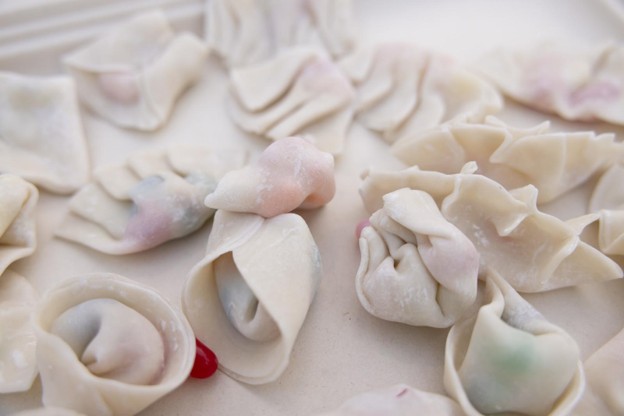
While thoughtfully introducing food as a topic can be expansive, there remains something undeniably special about bringing in actual food. However, engaging food as a material isn’t without its tensions.
One educator brought up the issue of using free food to persuade people to come. Very often, she recounted, this results in a dynamic where the people who attend are not here for the actual program or event, and “just come for the food, then dip.” If we dig deeper into the discomfort of this dynamic, it signals three possible tensions: 1) the food is inherently not the main focus of the program, yet it is the main draw, 2) there are currently untapped possibilities to connect the specific food to the program at hand; 3) depending on the communities served by the museum, there may be larger issues of food insecurity at hand.
Though the third reason demands more sustained, broader wrap-around services with collaboration across community and policy sectors, the first two tensions can be addressed through the intentional integration of food as a domain of learning which connects knowledge across visitors’ lived experience. In other words, when we do incorporate food, how can we reframe it as an educational material as deserving of deep consideration as any other materials we’re choosing?
Food, even as it is consumed and disappears, can be thought of as a material of a learning experience—one to be chosen with care, and presented in ways that allow for learners to engage with it past eating it. This can be understood as a philosophical shift in how we think about food as museum professionals. How can the food, itself, be an opportunity for attendees to interact with the ideas of the initiative at hand?
Food, even as it is consumed and disappears, can be thought of as a material of a learning experience—one to be chosen with care.
For example, during the development of a new STEM demonstration for our visitors, our Explainers (youth staff) explored flour through hands-on experimentation and recipe making. Observing how the material behaved led them to ask their own STEM questions and pursue new lines of inquiry (e.g. Why isn’t my dough stretchy?; How much water is too much?). In this example, the food was not being consumed; it was treated as a material for learning and discovery.
Food as convener

As museum professionals, we choose materials and frame the learning we hope to happen with care. We also structure spaces around these materials with intention. Thinking about food as a learning tool also points to questions around how we structure participants’ interactions with and around food. Rather than regarding food as an isolated component that we hope draws participants, what deeper intentionality can we plan for around people’s interaction with food in our programs?
At our museum, one of our prime intentions is using food as a convener. We build in a “breaking bread” section of our programs as a way of grounding in the space, building relationships, and taking care of our participants. While the term “breaking bread” has religious origins, the idea of sharing a meal to cultivate a sense of togetherness is near universal. For events where community-building is important, structuring time to break bread is a deliberate component.
We saw this distinct dynamic come to life in our Explainer Conversations series, a youth-developed, youth-centered space where high school and college-aged Explainers take the lead on the conversations that matter most to them. This project allows the youth to design and lead workshops rooted in their own lived experiences, cultures, and everyday realities.
When we developed this workshop series, food was an absolute non-negotiable. We saw how our participants instantly opened up and fell into organic conversation when serving themselves and eating with their peers. We deliberately leveraged that natural, communal comfort to help open up dialogue around whatever topic was the focus of that evening.
How can we use food as a scaffolding for relationship building and dialogue?
In that roundtable session, museum education professionals spanning arts, culture, society, and STEM in New York City showed excitement at the possibility of bringing food into the various topical and geographic spaces their cultural institutions serve. From the energy in that room, it was clear there is a strong desire to continue this work paired with an uncertainty about how exactly to do it amidst different museum contexts and policies. It is also clear that these conversations are missing to the degree they are required in our professional community to seriously address the taboo and anxieties of food in the museum, and how they limit our ability to provide more inclusive, community-centered onramps to informal learning.
In any case, these reactions signal to us a need for our professional community to push on what incorporating food can look like in museums, who we can reach through thoughtfully incorporating it, and the ends to/care with which we will work as individuals and institutions to make that happen. It is clear that bringing food into the museum is something that is on the minds and hearts of community-oriented museum professionals looking to invite broader, historically-underserved audiences in their institutions.
Across New York City and beyond, food and community have long been connected and tied to proud cultural histories. Intentionally bringing food as a topic, material, and/or convener into our museums can be a powerful way of doing work that actively invites in more of our underserved communities. For our museum community at large, how might we incorporate food in our museums in ways that bring in missing perspectives and allow us to take a closer look at ourselves and the world around us?