
The MathFinder app was developed by talkSTEM and SMU with support from National Science Foundation (2-minute video).
Math is uniquely associated with anxiety and phobia. When was the last time you heard anyone say they were “history-phobic”?
And yet, math is woven into nearly every part of life and every place we move through: art, architecture, music, nature, and sports. At work, at play, or simply walking down the street, we are constantly encountering math. That is why we need a new kind of math education—developmentally appropriate approaches that feel social, personalized, and responsive to different interests, including kids who see themselves as “good at math” and kids who do not. We need to feature math that is tightly connected to the places and activities that children visit, and present it in a way that is meaningful and relevant to children’s lives.
We also need to move beyond a model centered on students simply answering questions, especially when many are already using AI to complete their homework. If AI can answer nearly any question posed by a textbook or a teacher, the challenge is to use it instead to spark curiosity and critical thinking. If educators are serious about meeting students where they are, they should engage with the technologies students are already using, only in impactful ways that foster curiosity and higher-order thinking skills. At talkSTEM and at SMU, that conviction led us to build an AI tool that supports critical thinking, not flattens it.
talkSTEM is a nonprofit organization whose mission is to make Science, Technology, Engineering, and Math (STEM) learning engaging for all learners. We have collaborated with Southern Methodist University (SMU) for over ten years on research and development of learning resources, all of which are open-access and virtually accessible from anywhere in the country. Place- and inquiry-based learning has served as the backbone for all of talkSTEM’s learning resources, and for almost five years, talkSTEM and SMU have collaborated on the development of the MathFinder app, with support from the National Science Foundation.
Together, talkSTEM and SMU are thrilled to introduce the Mathfinder Question-Asking Tool, a custom generative AI tool rooted in inquiry and place-based exploration. We believe this tool can be an invaluable resource for educators, particularly in informal learning settings. It is an easy-to-use tool that is part of a thoughtfully constructed platform and suite of resources designed and proven to increase youth engagement in Math and STEM.
MathFinder: Helping Youth See Math Questions Everywhere
Most of talkSTEM’s resources are rooted in the walkSTEM initiative, which includes the MathFinder project, an organized, informal, place-based activity in which participants go on in-person or virtual walks and notice and wonder about how mathematics and STEM appear in the world. We define mathematics as a language that can be used to describe and interrogate the world around us, which includes both qualitative as well as quantitative strategies. Our approach makes math more social, personal, and relevant by connecting learning to students’ own places and experiences. We draw on theories of place‑based learning, interest development, and mathematical problem‑posing, turning museums, zoos, playgrounds, soccer fields, and other everyday spaces into sites of inquiry.

“When educators and students design walk stops, they create experiences that deepen the Zoo visit by helping learners notice and explore mathematical concepts in the same authentic settings where animal care, research, and conservation work take place.”
— Amanda Stephens-Robers, Supervisor of Camps and Teen Programs at the Dallas Zoo
Take, for example, a video talkSTEM made with the Frontiers of Flight Museum in Dallas, showcasing the command module of Apollo 7—the 1968 Apollo mission that first flight-tested the systems and procedures required for the moon mission.
Looking at the command module, a question comes to mind:
Why is it shaped like a cone (or more specifically, a cone with its apex lopped off)?
The students brainstorm a possible explanation—either individually or working together—with the educator providing guidance. After that, the educator might encourage students to ask their own questions about the Apollo module, or whatever else they notice in that room. This second level of engagement allows students to personalize their experience—noticing and asking questions rooted in their individual point of view.

The Lunar module’s truncated cone shape allowed it to survive the unfathomable speed and heat of re-entry. As you look at the module, what do YOU notice? View full video.
The Lunar module math walk is available on talkSTEM’s free online library of approximately 300 existing STEM and math walk videos, created with partners including the National Museum of Mathematics, the Dallas Zoo, and the Dallas Arboretum. The partner list is growing and talkSTEM welcomes collaboration with additional institutions. Each 1-4 minute video features a key, observation-based question in a specific location and a quick response strategy to the question. These open-access videos are used by talkSTEM’s partner sites across Dallas and other cities during field trips or camps as well as by other youth-serving organizations, including schools, allowing for quick, inquiry-based field trips and discussions. Educators at these sites also use talkSTEM’s tools to develop math and STEM walks of their own.
The lunar module math walk is “a natural extension of the education programs we offer every day, and a reminder that the museum can be a living classroom for anyone who walks through our doors.”
— Rosalie Wade, Director of Education at Frontiers of Flight Museum
MathFinder Question-Asking Tool: Using AI to Foster Deeper Inquiry
Last year, talkSTEM’s partner, Southern Methodist University, developed the Mathfinder Question-Asking Tool, a generative AI tool that helps students and educators develop meaningful, grade-appropriate math and science questions from real-life images in places that matter to them.
We built this tool in response to deep interest from both informal and formal educators in developing Math and STEM walks at their own sites. We wanted to encourage and support educators who want to create these walk experiences for their students, and to allow students to create walks in their places of interest. We believe this resource, developed with support from the National Science Foundation (NSF), can be an invaluable resource for educators, particularly in informal learning settings—an easy-to-use platform that saves educators time and allows them to create more diverse content that increases student engagement.
The goal is not simply to have math and STEM factoids presented to students, but to model curiosity and engage their critical-thinking skills by asking what they notice, what they wonder, and what kinds of questions are worth asking. A good question, in this framework, is personalized, relevant, and inquiry-driven: something answerable through observation, discussion, or measurement, not just something Google or Chat GPT can answer in seconds.
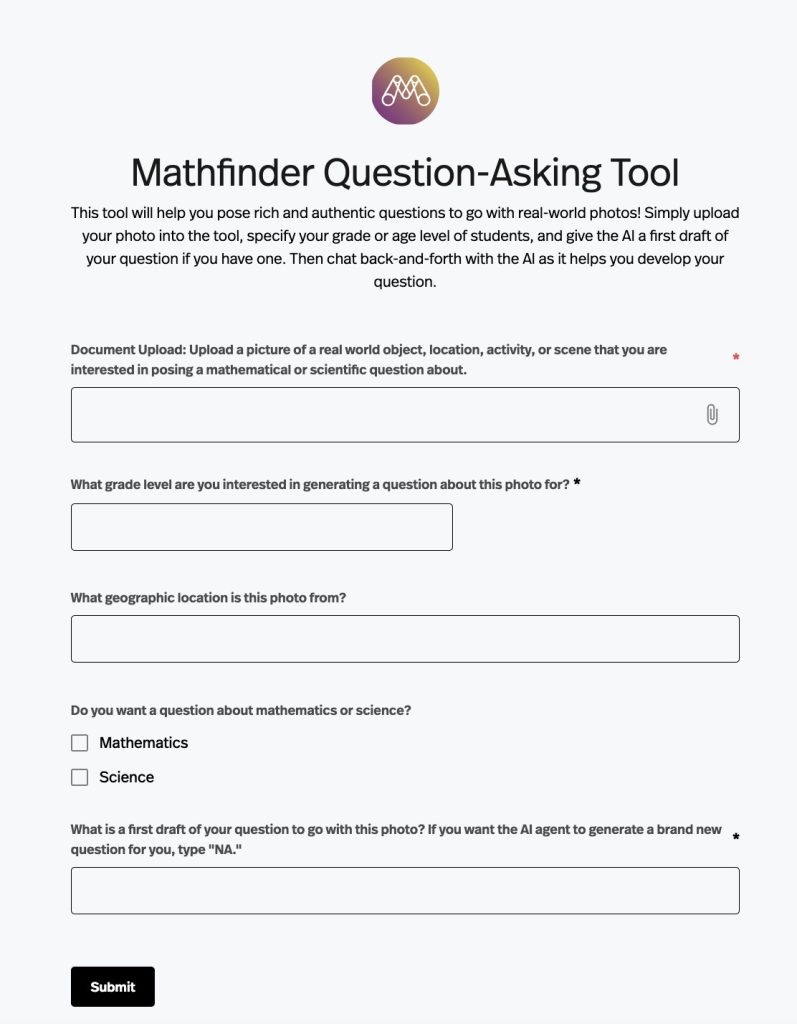
The Mathfinder Question-Asking Tool makes place- and inquiry-based learning easy and fun and is trained on talkSTEM’s research-based methods and resources.
The AI Question-Asking Tool in Action
Stegosaurs and Volleyball Players
Let’s say you’re a tour guide at a science museum, about to give a tour to a group of 8th-grade volleyball players who are in town for a tournament. Minutes before the tour begins, you upload a picture of the stegosaurus exhibit into the Question-Asking tool, then ask it to generate 8th-grade-appropriate math questions.
You get back the following response:

⛏️ Here are some ways to revise your question so it becomes more mathematical, open-ended, and 8th-grade appropriate, while still starting from the spikes/plates on the Stegosaurus:
Original: “Why does the dinosaur have spikes on its back?”
Option A: Geometry & Measurement
“How could we estimate the total surface area of all the plates on this Stegosaurus, and how does that compare to the surface area of its body?”
- Students can: define assumptions, model plates as simple shapes (triangles, rectangles, trapezoids), measure from the photo or signage, scale up, compare ratios/percentages.
Option B: Patterns & Functions
“If we number the plates from head to tail, what pattern do you notice in their size and spacing, and how could you represent that pattern with a graph or a function rule?”
- Students can: estimate plate heights, record data, plot on a coordinate plane, describe linear/nonlinear patterns, make conjectures.
Option C: Scale & Proportional Reasoning
“If one of the back plates is about ____ cm tall in this photo and the real plate is about ____ m tall (from the museum label or an online source), what scale factor does this photo use, and how could we use that to estimate the dinosaur’s total length?”
- Students can: work with scale factors, similar figures, proportional reasoning, unit conversions.
Option D: Stability & Center of Mass
“How might the size, shape, and arrangement of the plates affect the Stegosaurus’s balance? What kind of mathematical model could we build to estimate whether it would tip forward or backward?”
- Students can: reason about center of mass qualitatively, set up simplified “beam with weights” models, make and test assumptions.
Option E: Optimization / Trade-offs
“Imagine each plate adds protection but also extra mass. How could we use math to explore whether this number and size of plates seems ‘efficient’ for the dinosaur—too many, too few, or about right?”
- Students can: invent simple quantitative models (e.g., benefit vs. cost), define variables, make tables/graphs, debate different reasonable answers.
If you’d like, tell me which of these directions (geometry, patterns, scale, balance, or optimization) fits best with your current unit, and I can help you turn it into a short task or mini-investigation aligned to 8th-grade standards.
These questions are academically appropriate, but you want them to be more relevant to a group of volleyball players, so you ask the tool to generate three additional questions that might resonate with these girls, and within seconds you receive the following reply:
Here are three mathematically rich, volleyball-friendly questions you could pose with the Stegosaurus photo for 8th graders:
1. Spike Reach vs. Plate Height
“If a front-row volleyball player can reach about 9 feet on a spike, how could we estimate whether she could touch the highest plate on this Stegosaurus? What measurements or scale assumptions would we need from the photo or museum labels, and how could we model this comparison?”
2. Defensive Coverage: Dinosaur vs. Volleyball Team
“Imagine the Stegosaurus is ‘defending’ its body the way a back row defends the court. How could we estimate what fraction of its body surface is covered by plates and spikes? What simplifying geometric shapes and measurements might we use, and how would our assumptions change the answer?”
3. Training Plan: Speed, Stride, and Court Length
“Suppose this Stegosaurus ran at about __ meters per second (you choose a reasonable estimate based on its size). If our volleyball team used that same speed for conditioning, how many times across a standard volleyball court would equal the same distance the dinosaur might cover in 30 seconds? How could we set up a proportion or function to compare dinosaur distances to our volleyball drills?”
If you’d like, I can help turn one of these into a polished worksheet or classroom-ready activity.
Suddenly, the questions are a lot more specific (and creative!). The idea of a stegosaurus playing volleyball is imaginative and pretty funny, which engages student interest, and the question is about math concepts that are relevant to what they are learning in school. You might continue iterating with the tool to refine your questions or turn these questions into a worksheet you can use during the tour. Questions can be further iterated to account for the time of year, a recent news story, a pop culture moment, or literally anything else the educator thinks might spark curiosity. The more creatively the educator uses the AI tool, the better the result.
In practice, an educator might create three STEM or math walk stops during a field trip to a science center, with students discussing a generated question at each stop, then return to the classroom, display a photo from one of the exhibits, and have groups of three or four students generate different questions of their own based on that image. If the first two levels of engagement are successful, the educator might encourage students to directly use the Question-Asking tool. This resource is designed for flexible usage by informal educators and there are so many ways to use it to enhance programming at all sites. Through these levels of engagement and others, the Question-Asking tool becomes a tremendously flexible resource for extending field-trip learning, supporting small-group conversation, and helping educators create more personalized, place-based explorations that connect to students’ lived experience.
We hope all ASTC affiliates will use these tools to facilitate place-based explorations at their site. Our goal is not to automate education but to humanize it. When educators have the right tools, curiosity becomes contagious.
Explore Resources for Math Inquiry
To stay informed about new resources, join the talkSTEM community and follow on Instagram (@talkingSTEM) and Linkedin (@talkSTEM). If you’d like to start a deeper conversation, you can reach out to us directly at koshi@talkstem.org.

Use the Math-Finder Question-Asking Tool to facilitate place-based explorations at your site
Access more free MathFinder resources, supported by the National Science Foundation
Download the free MathFinder game for ipads from the app store