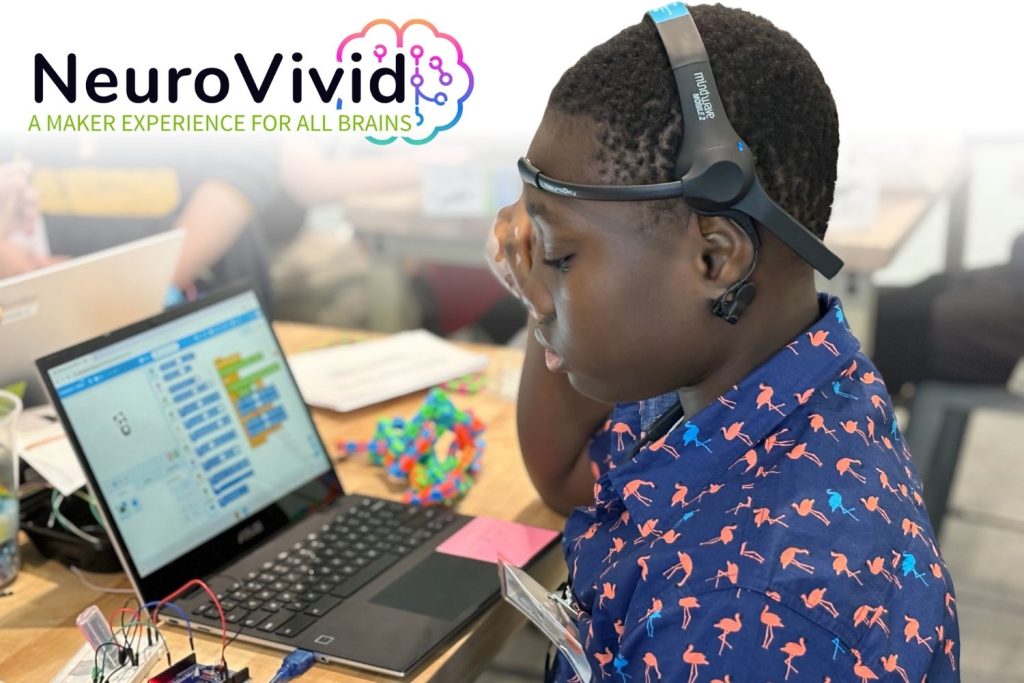
Walking into the final showcase of NeuroVivid camp, one saw a buzzing room of middle schoolers wearing Electroencephalogram (EEG) headsets and proudly demonstrating how their brain waves can power custom-made circuit creations. NeuroVivid camp was a program developed by TERC, New York Hall of Science, and Education Development Center to empower neurodivergent middle schoolers from different backgrounds to use EEG headsets to understand and interact with their brain activity. Over five days, campers built social connections, explored the museum, experimented with emerging technologies, and participated in individualized STEM experiences. Together, these activities culminated in creative circuit projects that integrated brain-computer interface (BCI) technology in which campers used brainwave-powered headsets to control objects with their minds!
Throughout the development of NeuroVivid, the project team from TERC, New York Hall of Science, and Education Development Center explored strategies to help neurodivergent individuals have positive experiences in informal STEM learning programs.
The term neurodivergent includes a range of neurological differences including autism, ADHD, dyslexia, and dysgraphia. Like neurotypical individuals, neurodivergent people are heterogenous with their own strengths, interests, and needs (Dwyer, 2022). Many neurodivergent individuals have strengths that align well with STEM, including pattern recognition, systematic thinking, seeing things through different perspectives, and the ability to focus deeply on topics of interest (Asbell-Clark, 2023).
Recognizing middle school as a key developmental period for academic and social growth, we chose to design the NeuroVivid program for neurodivergent youth in that age group. Across three years of piloting and refining the camp, the team identified several barriers that can prevent neurodivergent learners from fully participating in STEM programs, along with strategies to address them.
Through the program, we identified key strategies for well-designed learning structures:
Provide flexible routines that balance learning, play, and rest
The core STEM focus of NeuroVivid was for campers to design and build customized circuits that integrate Arduino microcontrollers, block-based coding, and BCI technology. In designing the program, we wanted campers to not only learn the STEM content, but also to build social connections, feel a sense of belonging, and have fun.
The five-day camp format provided the best pathway to ensure campers had enough time to get comfortable with the museum, build authentic connections, learn the STEM content, apply it to a personally meaningful project, and ultimately feel comfortable enough to be themselves in the camp environment. To achieve this, we designed the camp schedule to be both flexible and predictable. Each camp day followed a consistent schedule that balanced focused learning, play, breaks, and self-directed exploration.
The STEM content was divided into five modules introduced at the same time each day, with each module helping campers develop the skills needed to create an independent project. Since completing the modules required focused learning in a step-by-step process, choice was embedded into the design and implementation of the modules. Campers were given the option to work independently, with a partner, or with a facilitator’s guidance. Content was offered in multiple modalities, including visual guides that provided images and diagrams of each step, as well as guides with detailed written instructions.
| Suggested Camp Schedule | |
|---|---|
|
Arrival and acclimation |
Provide time to transition to the classroom and camp environment before activities begin. |
|
Icebreaker |
Choose an icebreaker based on camp energy, accessibility needs, and group dynamics. Examples include movement-based games, situational puzzles, and maker activities. |
|
Focused learning |
Accomplish core learning goals during this time (five modules). |
|
Lunch |
If possible, encourage members of the facilitation team to alternate eating with the campers. This can help build trust and connection. |
|
Exploration and play |
Choose an exploration or play-based activity depending on camper energy levels. This can include visiting a museum exhibit or playing in an outdoor space. |
|
Unstructured learning |
Provide multiple independent STEAM activities that connect to the content. Campers can choose what they engage with and follow their own pace. |
|
Dismissal |
Before leaving, recap what happened that day and what will happen the next day. |
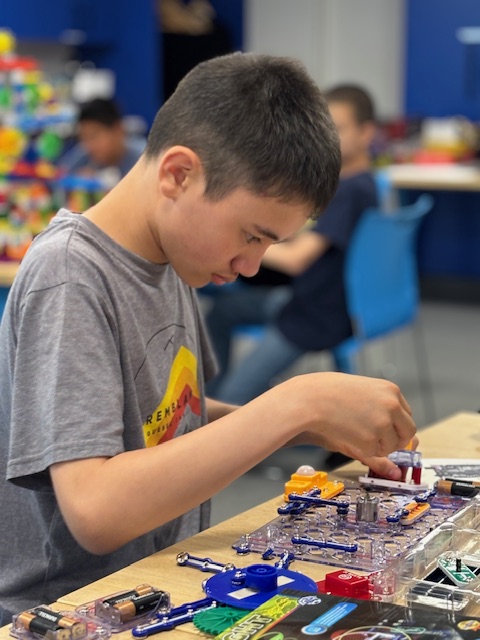
Campers could choose which activities they wanted to try and move at their own pace. Many of the camp’s strongest social connections were formed during these unstructured moments. The camper in the photo is creating a circuit using a Snap Circuits® kit. / photo courtesy of TERC
As campers completed the modules, they could choose from multiple extensions to continue learning and exploring the technology.
For each module, campers were given their own supply trays, each containing the exact amount of materials they’d need for that module. Consistency between the visual guides and physical materials was essential. Care was taken to avoid even small discrepancies, such as different colored components or extra materials on the table, which could create confusion and disrupt engagement. Midway through the module, instructors would gauge the energy of the room and decide when to have a quick snack and hydration break.
Following lunch and an exploration or play-based activity, the remainder of the camp day was dedicated to self-directed learning. Unfacilitated activities were set up throughout the classroom, with each activity connecting to the core STEM goals. Activities included off-the-shelf circuit kits (e.g., Snap Circuits®), coding challenges, maker/craft activities, videos about BCI, BCI games, and additional module extensions.
Support facilitators through training, reflection, and collaboration
One of the biggest challenges we identified in creating successful programming for neurodivergent learners was preparing staff to respond flexibly and confidently to a wide range of learner needs. Throughout the program, we implemented three phases of staff training to create the optimal experience for both campers and facilitators.
Pre-Camp Training
Before the camp began, we provided a three-hour training session for all facilitators and staff members who would be working with the campers. This included intentional context setting, clarifying the goals of the program, sharing clear and concise descriptions of staff responsibilities and expectations, and going over camp rules and policies. Additionally, the training included an overview of neurodiversity and different forms of neurodivergence that helped prepare staff for what to expect, how to recognize common situations that may arise, and better understand the campers. The training also covered strategies for supporting neurodivergent learners (such as the use of visual guides) and how to implement these strategies. We found it was critical for facilitators to understand and engage with the camp content, activities, and support materials directly.
In-the-Moment Training
A lot of facilitator training happened in the moment since all campers brought unique needs, strengths, and challenges that couldn’t be anticipated in advance. Experienced facilitators were encouraged to model facilitation and classroom management strategies for less-experienced facilitators. This included modeling the acceptance and normalization of neurodivergent traits and behaviors, calmly and respectfully redirecting when significant disruptions occurred, identifying campers’ strengths and encouraging them to use them to assist others, and demonstrating how to de-escalate social tensions. Experienced facilitators were also responsible for actively observing camp dynamics and individual camper engagement, and delegating support as needed—for example, noticing when campers were distracted, shut down, or overwhelmed, and delegating timely and strategic support. Support strategies included casual check-ins (even if the camper appeared focused), breaking tasks into smaller steps, modeling how to do challenging steps, or partnering with a camper to complete tasks in a way that supported the camper’s strengths. For example, if the camper struggled with fine motor control, the camper read the instructions and directed the facilitator to assemble the circuit.
Establishing a Reflective Practice
The lead facilitators implemented a structured, continuous reflective practice to help all facilitators refine their approach and meet individual camper needs throughout the week. After each camp day, the facilitation team debriefed and reflected as a group, identifying what went well and what needed improvement. Facilitators were encouraged to share how they supported individual campers and which strategies were successful or unsuccessful. The team shared observations, strategies, and perspectives from the day, with experienced facilitators providing guidance, feedback, and suggestions for the less-experienced facilitators. Based on the debrief, the team formed a plan for the following day. The facilitation team also discussed how to continue building trust and positive rapport with the campers, and whether the balance of structure, play, physical activity, and opportunities for breaks needed to be adjusted.
Create a community space where campers can be themselves
Establishing community agreements with campers helped set expectations while also creating a culture of acceptance and belonging. These agreements were written in a large, visible space that remained accessible throughout the week. Suggested agreements from campers often included fairness, respecting boundaries, kindness, and taking turns speaking.
Beyond establishing behavioral expectations, community agreements also created an opportunity to intentionally normalize neurodivergent ways of being. If campers didn’t independently suggest agreements related to stimming, sensory needs, or communication differences (e.g. “it’s ok to stand up and move around”), the facilitators intentionally introduced these concepts during the agreement-making process. Specifically, facilitators introduced the philosophy of “space and grace” to help create a culture where neurodivergent traits are accepted and don’t need to be hidden. Facilitators explained that, in this camp, the campers weren’t expected to mask their neurodivergent traits in order to participate, socialize, or succeed. The facilitators emphasized the idea that there was no single “correct” way to engage with the space as long as campers were respecting the safety and boundaries of others.
The majority of the circuit projects used the EEG headset to sense relaxed vs. concentrated brainwaves. The camper in this photo is using his concentration to power a fan to turn on and lift a styrofoam ball. / photo courtesy of TERC
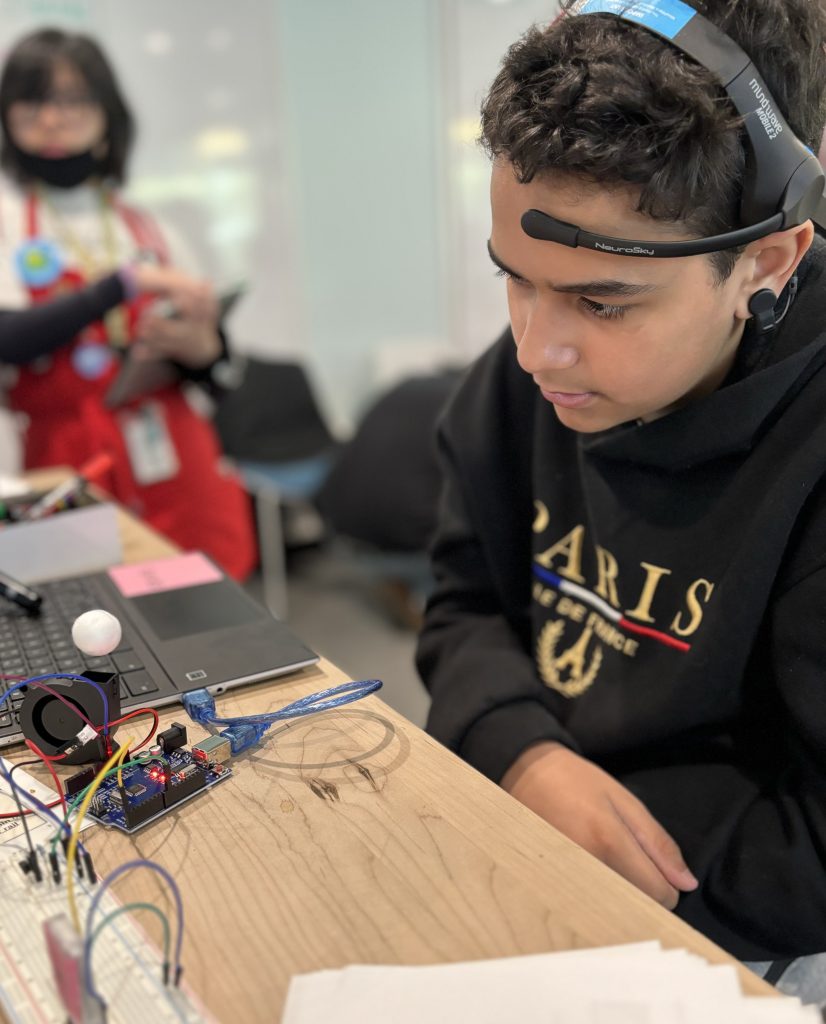
The majority of the circuit projects used the EEG headset to sense relaxed vs. concentrated brainwaves. The camper in this photo is using his concentration to power a fan to turn on and lift a styrofoam ball. / photo courtesy of TERC
Consistently adhering to the agreements was as important as establishing them. When agreements were broken, facilitators would calmly revisit the shared language used when the agreements were created, and physically point to where the agreements were displayed in the room. Reading the agreements each morning also allowed campers to reflect on previous challenges, advocate for their needs, and help shape the camp culture. In some cases, campers suggested new agreements after experiencing moments of discomfort or conflict, creating opportunities for self-advocacy.
Encouraging unmasking, which refers to expressing one’s neurodivergent traits more authentically, created an environment where campers could participate as themselves with less social exhaustion or burnout (Cage & Troxell-Whitman, 2019). This culture of unmasking was supported in several ways:
Attitude of Acceptance
Facilitators modeled an attitudinal acceptance of neurodivergent traits, responding in ways that didn’t evoke shame or punishment of behaviors related to self-regulation or communication differences.
Sensory Accommodations
The team also intentionally reduced sensory overload through the design and culture of the camp classroom. This supported campers’ ability to focus and regulate. Tables and chairs were spaced out, allowing campers to have personal space but still be able to easily connect with those seated near them. A quiet space was set up in the back of the room that allowed campers to take a break from the program and recharge as needed. The space had beanbags, lava lamps, sensory toys, coloring supplies, noise-cancelling headphones, and dimmed lighting.
Social Flexibility
Campers were encouraged to socialize, but socialization was never forced. Opportunities for connection were consistently available, and campers were able to engage with others at their own choosing.
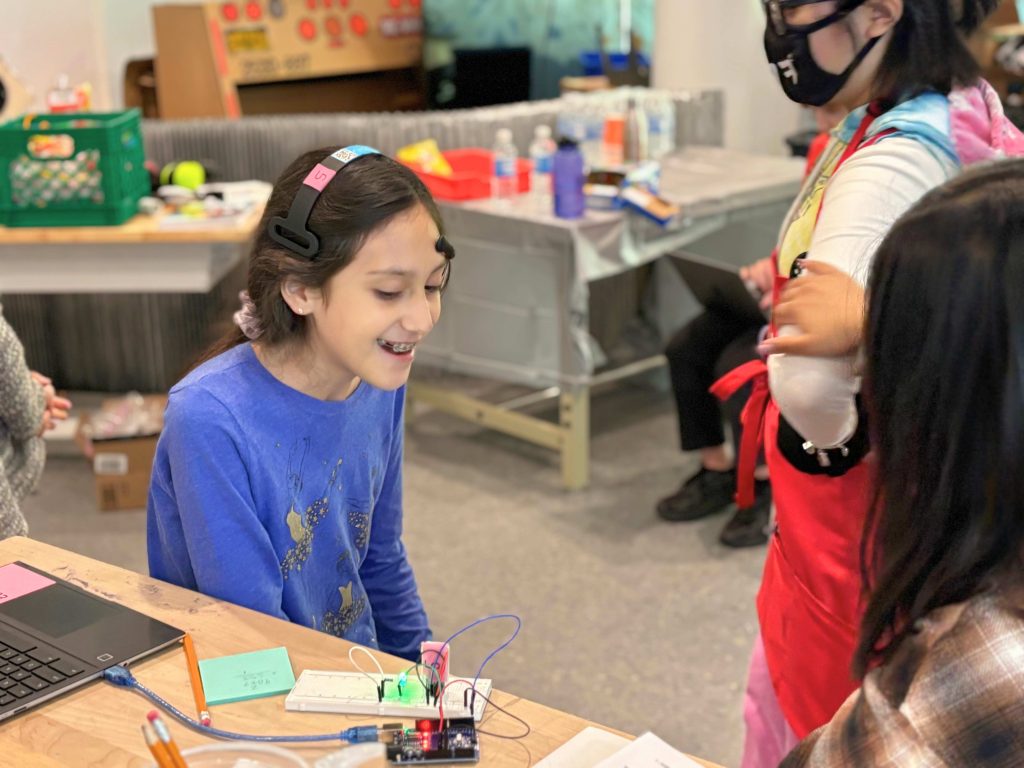
Since most circuits would only work if the EEG headsets sensed concentrated energy, several campers asked the Explainers to give them math problems to solve. In this image, a camper is concentrating on solving a math problem written on a post-it. / Photo courtesy of TERC
Over the course of five days, campers explored new technology, developed new skills, and created personalized circuit projects powered by their own brain waves. Equally as important, they built connections with other campers and facilitators, explored their own interests, had space to advocate for their needs, and ultimately were able to be themselves. Throughout NeuroVivid, it became increasingly clear that inclusive STEM programming relies on intentional program design that balances structure and flexibility, invests in facilitator training and reflection, and creates a culture of acceptance.
Learn more about the NeuroVid project and access example activities. For additional information about the camp or how to get the full set of materials, please contact ndinstem@terc.edu.
References
Asbell-Clarke, J. (2023). Reaching and teaching neurodivergent learners in STEM: Strategies for embracing uniquely talented problem solvers. Routledge.
Dwyer, P. (2022). The neurodiversity approach(es): What are they and what do they mean for researchers? Human Development 66, 73–92. https:// doi.org/10.1159/000523723
Cage, E., & Troxell-Whitman, Z. (2019). Understanding the reasons, contexts and costs of camouflaging for autistic adults. Journal of Autism and Developmental Disorders, 49(5), 1899-1911.